High-risk merchants: what it means and how to navigate it
High-risk merchants: what it means and how to navigate it

Most business owners assume that accepting credit card payments works the same way regardless of what they sell. That assumption can cost you. If you run a CBD shop, a vaping retailer, or a supplement business, your payment processor may have already flagged your account as high risk without ever telling you why. This classification affects your fees, your reserve requirements, and even whether your account stays open. Understanding what high-risk merchant status actually means, and how to work within it strategically, is one of the most practical things you can do to protect your revenue and your operations.
Table of Contents
- What is a high-risk merchant?
- How payment processors determine high-risk status
- Unique challenges high-risk merchants face
- How to compare and choose high-risk payment processors
- Why most guides underestimate the human factor in high-risk payments
- Get expert high-risk merchant support
- Frequently asked questions
Key Takeaways
| Point | Details |
|---|---|
| Definition matters | High-risk merchants are businesses in sectors with greater payment or regulatory risks, leading to stricter account terms. |
| Processor criteria | Factors like industry, chargeback rates, and regulations determine your high-risk merchant status. |
| Costs and challenges | High-risk merchants often pay higher fees, face reserve requirements, and must meet tough compliance benchmarks. |
| Comparison is vital | Carefully compare processors on more than just rates; look at overall terms, support, and transparency. |
| Partnering smartly | Building strong communication with your processor can help minimize disruption and improve long-term outcomes. |
What is a high-risk merchant?
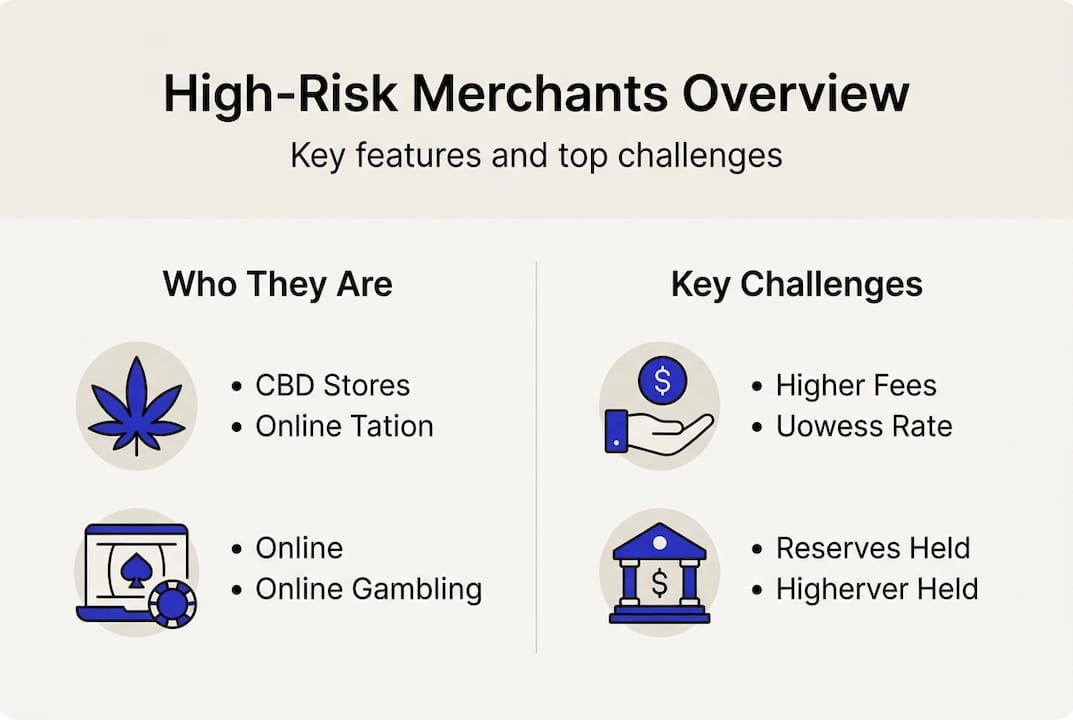
Not all merchant accounts are created equal. When a payment processor or acquiring bank evaluates your business, they assess the likelihood that processing your transactions will expose them to financial or legal complications. A high-risk merchant is a business that banks and payment processors view as having an elevated likelihood of payment issues such as fraud, chargebacks, or regulatory and reputational complications.
This label is not a moral judgment. It is a financial risk calculation. Processors look at your industry, your average transaction size, your customer base, and your history. If any of those factors suggest elevated exposure, you get classified accordingly.
Common industries that routinely receive high-risk classification include:
- CBD and hemp products
- Vaping and e-cigarette retailers
- Adult content and entertainment
- Online travel agencies
- Nutraceuticals and dietary supplements
- Online gaming and gambling
- Firearms and ammunition
- Subscription box services with high cancellation rates
You will notice that many of these industries are perfectly legal and widely profitable. The classification is not about legality. It is about the statistical likelihood of chargebacks, fraud attempts, or sudden regulatory shifts that could leave a processor holding the bag.
“High-risk merchants face stricter terms and higher fees because processors must account for the increased financial exposure that comes with these business categories.”
For a broader look at how this applies to your specific sector, the high-risk merchant account overview at Merchant Solutions Corp outlines what businesses in these categories can realistically expect. If you want a deeper breakdown of account structures, high-risk merchant services explained walks through the options available to you.
How payment processors determine high-risk status
Understanding the definition is essential, but how do processors actually decide if you are high risk? Here is what happens behind the scenes.
Processors use a combination of automated screening and manual underwriting to evaluate every new merchant application. High-risk accounts are underwritten with stricter terms because of processors’ increased exposure to chargebacks, fraud, and regulatory uncertainty. The following factors most commonly trigger a high-risk classification:
- Industry type. Some sectors are automatically flagged regardless of your individual business record. CBD and vaping fall into this category in most underwriting systems.
- Chargeback history. A chargeback ratio above 1% is a major red flag. Even a short history of disputes can shift your classification.
- Average transaction size. High ticket sales, particularly over $500, attract more scrutiny because fraud losses are larger per incident.
- Transaction volume and frequency. Rapid growth in processing volume can look suspicious to automated systems, even when it reflects legitimate business success.
- International sales. Cross-border transactions carry higher fraud rates and additional regulatory complexity.
- Regulatory environment. Industries where laws vary by state or are subject to ongoing legislative changes, like CBD, are inherently harder for processors to manage.
- Business age. Newer businesses lack the track record that reassures underwriters.
One of the most common misconceptions is that a clean business record protects you from a high-risk label. It does not. Your industry alone can determine your classification before a single transaction is processed. This surprises many owners who have operated responsibly for years.
For context on how standard retail businesses are evaluated differently, see how retail businesses are classified. Understanding that contrast helps you see exactly where the gap lies.
Pro Tip: Before you apply with any processor, ask them directly how they define high risk and what their underwriting criteria are. Get the answer in writing. This one step can save you weeks of back-and-forth after a rejection.
You can also review merchant security challenges to understand how compliance and fraud prevention factor into the underwriting process.
Unique challenges high-risk merchants face
So, what does this classification actually mean for your bottom line and everyday operations? The impacts are significant.

High-risk merchant accounts typically come with stricter terms, including higher fees and reserve and monitoring requirements. Here is how the numbers compare at a general level:
| Feature | Standard merchant | High-risk merchant |
|---|---|---|
| Processing rate | 1.5% to 2.9% | 3.5% to 5.5% |
| Monthly fees | $10 to $25 | $25 to $100+ |
| Rolling reserve | None or minimal | 5% to 10% held 90 to 180 days |
| Chargeback threshold | 1% before review | 0.5% to 1% before penalties |
| Contract length | Month to month | 1 to 3 years common |
Beyond the numbers, high-risk merchants deal with a set of operational challenges that standard businesses rarely encounter:
- Rolling reserves. A percentage of your revenue is held back by the processor for months as a financial cushion. This directly affects your cash flow.
- Account freezes and terminations. Processors can freeze or close accounts with limited notice if your risk profile changes or you trigger internal alerts.
- Stricter compliance checks. You will face more frequent audits and documentation requests.
- Integration limitations. Some payment gateways and POS systems simply refuse to work with high-risk merchants, narrowing your technology options.
- Reputational screening. Being placed on the MATCH list (Member Alert to Control High-Risk Merchants) can make it nearly impossible to get approved elsewhere.
For a clear picture of what fees look like in practice, review average high-risk fees to benchmark your current or prospective processor. You can also explore security and compliance challenges to understand what documentation and practices reduce your exposure.
How to compare and choose high-risk payment processors
With the challenges clear, how should you actually evaluate your options? Here is how to find the right fit for your business.
When comparing processors, do not use only the discount rate. High-risk programs often bundle higher discount rates with additional risk-related costs like reserves, monitoring fees, and early termination penalties. Looking at the rate alone gives you an incomplete picture.
Here is a practical framework for evaluating any high-risk processor:
| Evaluation criteria | What to look for |
|---|---|
| Processing rates | All-in cost, not just the advertised rate |
| Reserve requirements | Percentage held, duration, and release conditions |
| Contract terms | Length, early termination fees, renewal clauses |
| Chargeback management | Tools provided to dispute and prevent chargebacks |
| Customer support | Dedicated account managers vs. general support queues |
| Integration compatibility | Works with your existing POS or e-commerce platform |
| Industry experience | Has the processor worked with your specific sector before? |
Use this checklist to narrow your choices:
- Request the full fee schedule in writing before signing anything.
- Ask specifically about rolling reserve terms and when funds are released.
- Confirm which chargeback ratio triggers a review or account action.
- Ask for references from other merchants in your industry.
- Verify that the processor supports your preferred POS or gateway.
- Clarify what happens to your account if your volume grows rapidly.
Pro Tip: Never accept a verbal summary of fees. Ask for a complete written schedule that includes all monthly fees, per-transaction costs, reserve terms, and penalty clauses. Surprises in this industry almost always show up on your statement, not in the sales conversation.
For a side-by-side look at payment options suited to different business types, retail payment comparison provides a useful baseline for understanding what standard accounts offer versus high-risk alternatives.
Why most guides underestimate the human factor in high-risk payments
Most articles about high-risk merchant accounts stop at product features and fee comparisons. That is useful, but it misses something that experienced operators understand well. The relationship between you and your underwriter matters more than most people realize.
We have seen accounts with clean compliance records get frozen because the merchant never responded to a routine documentation request. We have also seen accounts in genuinely risky categories stay stable for years because the owner communicated proactively, flagged unusual transaction patterns before the processor noticed, and built a real working relationship with their account manager.
Hidden communication failures cause more account disruptions than minor paperwork errors. If your processor sends a request and you ignore it, that silence reads as evasion. Processors are not just evaluating your transactions. They are evaluating your responsiveness and transparency.
Investing in that relationship pays off. A processor who knows your business, understands your seasonal patterns, and trusts your communication is far less likely to freeze your account during a high-volume month. That kind of stability is worth more than a slightly lower processing rate. If you want to see what a well-structured partnership looks like in practice, modern payment solutions shows how proactive support can make a real operational difference.
Get expert high-risk merchant support
Navigating high-risk payment processing on your own is possible, but it takes time, research, and more than a few hard lessons. If you are ready to skip the trial and error, Merchant Solutions Corp works directly with businesses in high-risk sectors to build stable, cost-effective processing setups from day one.

From high-risk merchant services designed around your industry to high-risk merchant solutions that address reserves, compliance, and chargeback management, the goal is simple: fewer surprises, lower costs, and an account that stays open. Explore custom payment processing options or reach out to a specialist who understands your sector and can walk you through approval and setup.
Frequently asked questions
What are examples of high-risk merchants?
High-risk merchants include CBD stores, vaping retailers, online gambling platforms, adult content providers, dietary supplement sellers, and travel agencies. These industries share characteristics like elevated chargeback rates or complex regulatory environments.
Why do high-risk merchant accounts have higher fees?
Processors charge higher fees to offset the increased financial exposure that comes with elevated fraud and chargeback risk, as well as the added compliance burden of operating in regulated or volatile industries.
Can a standard business become high-risk over time?
Yes. Even businesses with clean records can shift into high-risk status if their chargeback ratio climbs, they expand into a regulated product category, or new legislation changes how their industry is viewed by processors.
How do I lower my risk profile?
Transparent communication and strong compliance are the foundation. Reducing chargebacks through better customer service, maintaining accurate documentation, and staying current with industry regulations all contribute to a stronger risk standing over time.